

For decades, the productivity world has had one answer to "how do I focus?"
More caffeine.
A flat white in the morning. A pre-workout at the gym. An energy drink at 2pm. Maybe a nootropic stack that's basically caffeine with extras. The model is the same: stimulate harder, push through.
For some people, this works. For a lot of people, particularly those with sensitive nervous systems, those who feel anxious on stimulants, and those who simply find caffeine stops working over time, it actively backfires.
This is for the second group.
The Stimulant Trap
Caffeine is genuinely useful in small doses. The problem isn't caffeine itself, it's the way most people use it.
Here's what happens when you rely on caffeine for focus:
Day 1: One coffee. Sharp focus. Productivity high.
Week 2: Same coffee, less effect. You add a second.
Month 2: Two coffees barely register. You add a pre-workout, an energy drink, or stronger coffee.
Month 6: You're consuming more stimulants than ever and feel less focused than you did six months ago. Anxiety has crept in. Sleep is shorter and lighter. The afternoon crash is worse.
This is tolerance. It's a measurable, predictable physiological adaptation, and it's why "more caffeine" is a strategy with diminishing returns.
The alternative isn't doing nothing. It's switching to inputs that support focus without escalation.
Who Benefits Most From Going Stimulant-Free
There are three groups for whom the stimulant model is a particularly bad fit.
1. People with sensitive nervous systems
You know who you are. Half a coffee makes you anxious. A pre-workout makes your heart pound. You can't drink anything caffeinated after midday or you don't sleep. Your nervous system is wired to respond strongly to adrenergic input, which is great for survival, less great for sitting calmly at a desk for four hours.
2. People who experience anxiety alongside focus issues
For some people, focus problems and anxiety are linked. Caffeine pushes both up at the same time. You become more alert and more anxious, which feels worse, not better.
3. People who find stimulants stop working
Tolerance is universal. Some people just hit it faster. If your useful caffeine dose has crept up over the years and you're still not focused, you've already proven that more stimulant isn't the answer.
What Stimulant-Free Focus Actually Looks Like
The premise is simple: rather than push the accelerator harder, support the underlying systems your brain uses to focus.
Calm-Alert State (Alpha Brain Waves)
Peak focus isn't maximum arousal, it's a specific state called calm-alert. Neurologically, it's associated with alpha brain wave activity, the pattern your brain produces when you're relaxed but engaged.
L-Theanine, an amino acid from tea leaves, has been shown in human studies to increase alpha wave activity. A 2008 paper in Asia Pacific Journal of Clinical Nutrition documented this directly, measurable, reproducible shifts in alpha activity following L-Theanine intake. (View study)
This is the opposite of the caffeine model. You don't get pushed forward, you get held still, with full attention available.
Cholinergic Support
Acetylcholine is the neurotransmitter most directly involved in focus, attention, and memory formation. It's not a stimulant. You don't feel a buzz from optimising it. You just think more cleanly.
Alpha-GPC supports acetylcholine production by providing readily available choline. A 2017 review in Clinical Therapeutics documented its association with cognitive function support. View study
The subjective experience: words come faster, ideas connect more easily, you remember the thing you walked into the room to do.
Nervous System Modulation
This is where stimulant-free formulations diverge most clearly from caffeine-based ones. Rather than push the sympathetic nervous system harder, the goal is to modulate it, keep it engaged without letting it overshoot.
β-Caryophyllene, a compound from hops and cloves, interacts with the CB2 receptor in the endocannabinoid system, which plays a role in modulating stress and inflammation responses. Research in Phytomedicine has documented its neuroprotective profile. View study
In plain terms: it helps the nervous system stay even, rather than swing.
A Stimulant-Free Daily Routine
Here's a routine that supports focus without depending on caffeine. You can layer caffeine on top if you want, but it's not the foundation.
6:30am, Light exposure
Get outside or near a bright window within 30 minutes of waking. This anchors your circadian rhythm and increases alertness naturally.
7:00am, Protein-forward breakfast
Protein at breakfast stabilises blood sugar for the morning. Eggs, Greek yoghurt, smoked salmon, leftover dinner, anything but cereal.
8:00am, Movement
Ten minutes is enough. Walk, mobility work, easy lifting. Increases cerebral blood flow.
8:30am, Stimulant-free nootropic support
Something like Megamind, taken with water.
9:00am, Deep work block 1
Phone in another room. Single tab. Ninety minutes.
10:30am, Break plus sunlight plus water
Five minutes. Don't skip this.
11:00am, Deep work block 2
Sixty to ninety minutes.
12:30pm, Real lunch
Protein, vegetables, fats. Not a sandwich and a Coke.
Afternoon, Optional caffeine
If you still want a coffee, this is when. Before 1pm if you sleep before 11pm.
The point: you've already done four hours of focused work before the first stimulant.
Where Megamind Fits
Stimulant-Free Focus: A Calmer Approach to Productivity
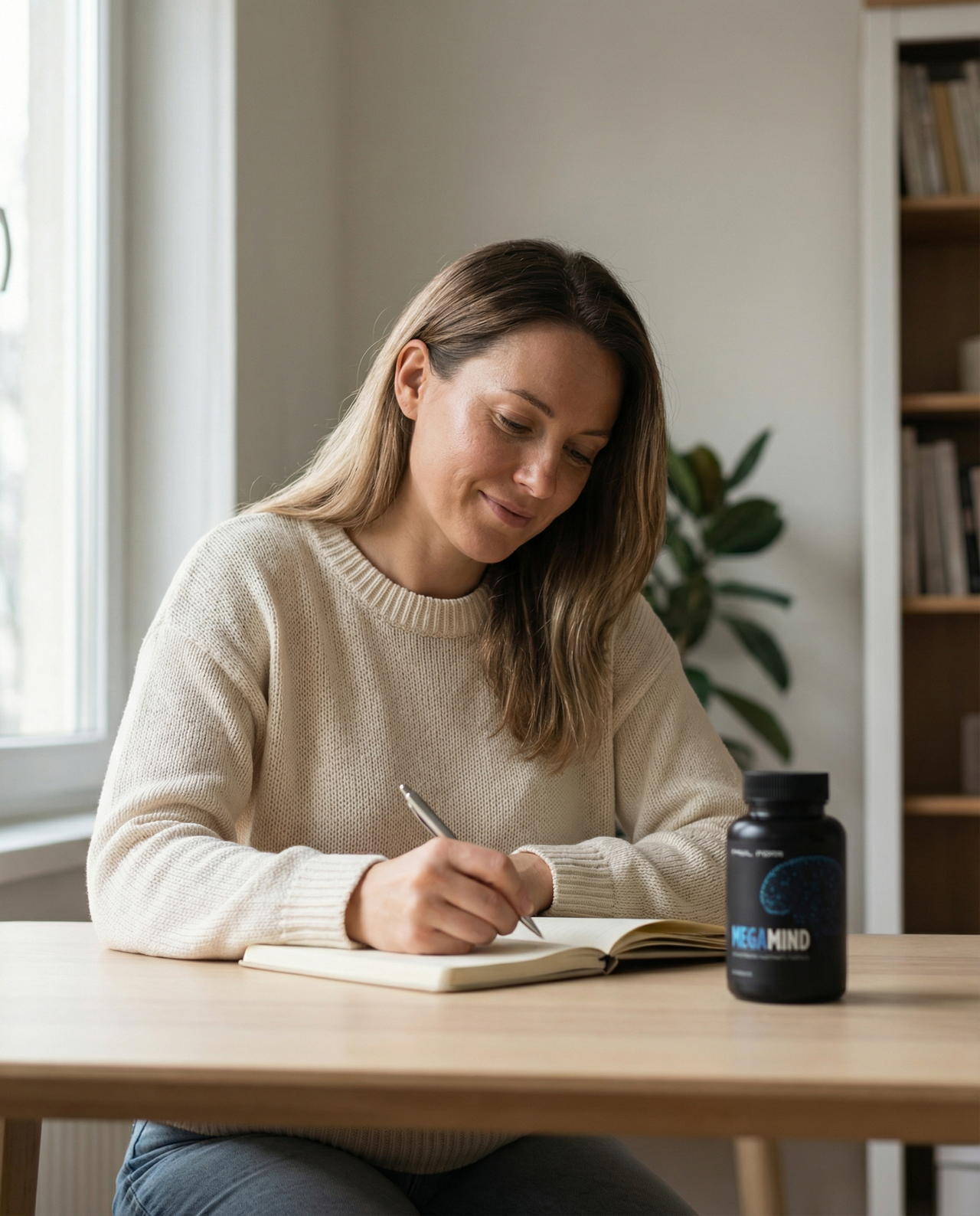
Megamind was built specifically for this model. It's a stimulant-free nootropic designed to support calm, sustained focus, without the jittery overshoot of caffeine-heavy formulations.
The combination of L-Theanine, Alpha-GPC, β-Caryophyllene, Lupin Extract, and Octopamine targets the underlying systems that produce focus, rather than artificially pushing the nervous system into over-arousal.
For people whose default has been "more coffee," it's a different kind of input. Not flatter, just smoother, longer, and without the crash.
The Bottom Line
If caffeine works for you, keep using it. If it doesn't, if you're anxious, tolerant, or simply tired of needing more to feel less, there's another model.
Stimulant-free focus isn't about doing without. It's about supporting your brain's actual focus systems, instead of overriding them.
This article is for informational purposes only. Megamind is a dietary supplement and is not intended to diagnose, treat, cure, or prevent any disease, including ADHD or other neurodivergent conditions. Always consult a healthcare professional before starting a new supplement regimen, particularly if you are managing a medical condition or taking prescription medication.




0 comments